Did we get the kegs? Did we find any prepaid legal services?
I haven't contacted the other home-brewery, but there is no trademark on the name and we can use it in the state.
Saturday, August 15, 2009

12 and 22oz brown glass bottle
I went by TricorBraun yesterday.
Brown crown top bottles
OI 12 oz pallet (144) cost: $ 0.36 (52)
OI 22 oz pallet (720) cost: $0.66 (475)
contact: Carl S. Lee
344-7575
(pretty nice)
Brown crown top bottles
OI 12 oz pallet (144) cost: $ 0.36 (52)
OI 22 oz pallet (720) cost: $0.66 (475)
contact: Carl S. Lee
344-7575
(pretty nice)
Tuesday, August 11, 2009
Stainless Steel Stockpots
Rob,
What size pot would you need if the kegs didn't work or we cant get kegs?
If you need 50 liters, a new 53qt stock pot is about $247. They are hard to find used. : (
What else do you need? Equipment 4 Less sells used restaurant equipment for reasonable prices, so let me know and I'll give them a call. I also know a guy called Denis who has some stuff. (It should be a man that deals with him, I'm not comfortable with him.)
What size pot would you need if the kegs didn't work or we cant get kegs?
If you need 50 liters, a new 53qt stock pot is about $247. They are hard to find used. : (
What else do you need? Equipment 4 Less sells used restaurant equipment for reasonable prices, so let me know and I'll give them a call. I also know a guy called Denis who has some stuff. (It should be a man that deals with him, I'm not comfortable with him.)
Review of 8/7 Meeting
I haven't been doing this, but I think it's a good idea.
Review of 8/7 Meeting
No Hate
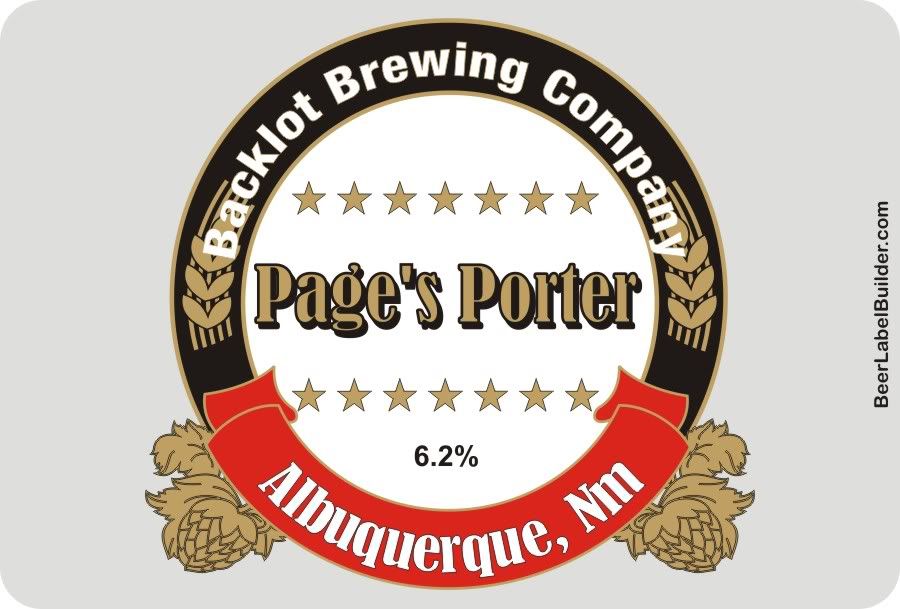
Name: Backlot Brewing Company
Legal: Jason in TX (maybe get some references for local lawyers?)
Business Entity: S Corp
Free nonalcoholic drinks for DD
Beer Brats and Burgers
To Do:
Marcus: prepaid legal services
Nick: Keg this week
Leigh: Backlot name and research logo design
Rob: Equipment list
Review of 8/7 Meeting
No Hate
Name: Backlot Brewing Company
Legal: Jason in TX (maybe get some references for local lawyers?)
Business Entity: S Corp
Free nonalcoholic drinks for DD
Beer Brats and Burgers
To Do:
Marcus: prepaid legal services
Nick: Keg this week
Leigh: Backlot name and research logo design
Rob: Equipment list
Sunday, August 9, 2009
Supplies
I think the first thing we need to procure is three stainless steel kegs. Nick, do you think this is possible? After that there is hardware we'll have to pick up for the frame, water works, heating, and chilling. The kegs are the first big hurdle though.
Logo Design Questions
*COMPANY-RELATED QUESTIONS*
1- How would you describe your services and/or products?
2- What are the long term goals of your company?
3- Why do you want a new logo? (if they already have one) What do you want your new logo to accomplish?
This question helps to understand the problem.
4- Who are your main competitors?
Having clients provide links allows you to get a better feel for their market and competition.
5- How are you different from your competitors?
6- What’s the age range of your target customer base?
Helps in creating an overall feeling and impression of the logo.
*PROJECT-RELATED QUESTIONS*
7- Do you have a tag line? If so, would you like it stated along side your logo?
8- Do you have any specific imagery in mind for your logo?
9- Do you have any color preferences, or existing brand colors?
10- Do you have any colors that you do not wish to use?
11- What adjectives should best describe your logo?
12- What feeling or message do you want your logo to convey to those who view it?
13- How do you prefer your logo to be worded or written out?
Example: thedesigncubicle or the design cubicle
14- How would you like the typography to appear?
Example: script, bold, light, hand drawn, custom lettering
15- Where will you logo be used?
Example: print, web…
16- Where will your logo primarily be used?
If the primary usage is for the web, typically horizontal logos work best.
17- What’s your preferred deadline, time frame or exact date of completion?
18- Budget?
This is where I provide various pricing and concept numbers.
19- Would you like any addition design services to be packaged with your new logo?
Example: business cards, envelops, letterheads, etc.
20- What logos appeal to you and why?
Another question they can also with links and visual examples.
Friday, August 7, 2009
Agenda for 8/7 MOTM
Brainstorm Names
Please bring some reference material for the brainstorming.
- define the qualities that you want your business to be identified with.
- looking in dictionaries, books and magazines
- your name should be easy to pronounce
- make sure that your name is in no way embarrassing
- take a close look at the competition
- weigh who's out there already, what type of branding approaches they have taken, and how you can use a name to separate yourself
- coined names can be even more meaningful than existing words
- What is needed
- Who needs some and for what
- Where will it come from?
- Tips from Nick?
- Questions for Nick
- Is Nick our IT person too!?
Please bring some reference material for the brainstorming.
Naming the business
Is naming a business harder than naming a baby?
Highlights:
• Overly clever, pun-filled names like The Hairport or The Family Hairloom. Har har.
• Totally boring, literal names like the now defunct Third Street Coffee House.
• Names that backfire completely when applied to internet URLs. Need a therapist? Try www.therapistfinder.com. Need some good art, go to www.speedofart.com. Looking for a nice pen? www.penisland.com.
Here are a few other examples of names, both good and bad:
• Federal Express became Fed Ex. A smart move, considering that’s what everyone called ‘em anyway. Besides, repainting all their jets with the new shorter logo saved the company millions year in fuel costs alone.
• Dress Barn??? How many women will admit to shopping there, much less bring herds of their friends in?
• Drug companies spend billions every year on names, yet they come up with some of the worst: “Nasalcom” for an inhaled antihistamine. Sounds like a rat poison that works when they sniff it. “Vagistat” for a yeast infection medicine. “Cutivate” for a skin condition medicine. Aspercreme for an ointment that doesn’t even have any aspirin in it. Not only are drug names often lame mash-ups of other words, the FTC recently concluded that dozens sound dangerously similar.
• Here are a few of my own: PointsWest for a resort development on the west side of Bend, Oregon. Sit Down Dinners for a personal chef service. Widgi Creek for a golf club.
LinkBranding
Webson made an analysis of the top 50 brands which should give some pointers to great logo design:
- The name does not describe the product sold (94%)
- The by-line tag is not included in the logo (90%)
- The font style is clean and clear (84%)
- The logo design uses one colour only (74%) (white & black not counted as a colour)
- The logo design uses letters only without the symbol (74%)
- The logo design is a made-up name or ACRONYM (72%)
- The logo design is rectangular in shape (66%)
- The logo design is one word only (62%)
- The logo design includes the trademark symbol (54%) and is placed in the top right (48%)
- The name is 6 letters or less (52%)
- The name uses upper & lower case (44%) (excluding ACRONYMS)
- The background is filled and solid. (52%)
- The pronunciation includes three sounds/syllables (44%)
- The predominant colour base is blue (40%)
FedEx isn't on here, which I think is one of the best logos evar.
http://brandinsightblog.com/category/branding/
Storytelling is a big part of branding. Once you’ve figured out the real crux of your brand, you have to communicate it in a form that people can understand. And nothing is more effective than a good, old-fashioned story. Doesn’t matter if it’s delivered via the latest, greatest mobile technology, it’s still just a story. Tell it well. Tell it often. And keep it real.
Saturday, August 1, 2009
Good article
I found this article online, take a look:
http://brewingtechniques.com/library/backissues/issue6.2/diebolt.html
http://brewingtechniques.com/library/backissues/issue6.2/diebolt.html
Subscribe to:
Comments (Atom)